

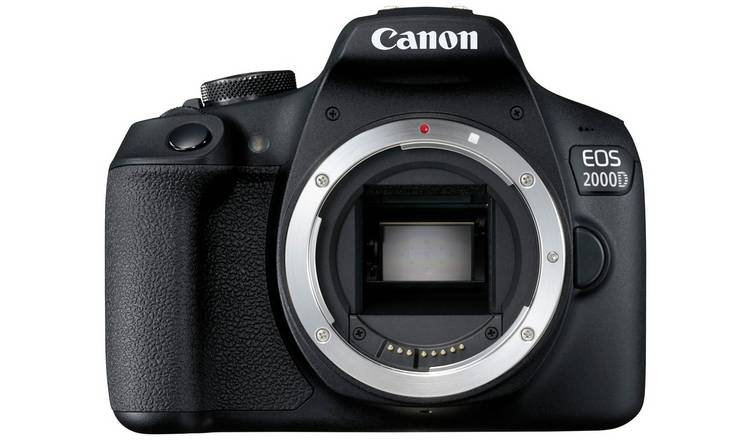
The Canon EOS 2000D, also known as the Rebel T7 in North America, is a straightforward entry-level DSLR built around a 24.1MP APS-C sensor. It offers an optical viewfinder, interchangeable EF/EF-S lenses, RAW capture and full manual exposure controls at a relatively accessible price.
Quick verdict: the EOS 2000D can still be a useful first camera in 2026 for learning still photography. Its sensor produces pleasing images in good light, battery life is respectable and used EF/EF-S lenses are widely available. Slow Live View autofocus, a 3fps burst, fixed non-touch screen and basic Full HD video make it a poor choice for action, vlogging or buyers expecting modern mirrorless features.
This article contains an Amazon affiliate link. If you buy through it, GottaPics may earn a commission at no additional cost to you.
Check Canon EOS 2000D availability on Amazon
Canon EOS 2000D key features
- 24.1MP APS-C CMOS sensor
- Canon DIGIC 4+ processor
- Canon EF and EF-S lens compatibility
- 9-point autofocus through the optical viewfinder
- JPEG and 14-bit RAW photography
- Full HD video at up to 30fps
- 3fps continuous shooting
- 3-inch fixed LCD with approximately 920,000 dots
- Wi-Fi and NFC
- Approximately 500 photographs per battery charge

Who is the EOS 2000D for?
The EOS 2000D is aimed primarily at beginners who want to move beyond automatic phone photography and learn how lenses, shutter speed, aperture and ISO affect an image. Its optical viewfinder and physical controls provide a traditional photographic experience without an overwhelming number of advanced settings.
It is best suited to landscapes, portraits, still life, holidays and general family photography. Sport, wildlife action, handheld video and social-media content are not its strengths because both its burst speed and screen-based autofocus are dated.
Design and handling
The camera weighs approximately 475g with its LP-E10 battery and a memory card. Its conventional DSLR grip is comfortable with small and medium lenses, while the mode dial and logically arranged buttons provide direct access to common shooting controls.
The body is predominantly plastic, but the lens mount is metal, unlike the cost-reduced plastic mount on the EOS 4000D. Build quality is appropriate for a beginner camera rather than demanding professional use. It is not weather-sealed, so it should be protected from rain, dust and condensation.

Screen and optical viewfinder
The fixed 3-inch LCD has approximately 920,000 dots and is noticeably clearer than the smaller screen on the EOS 4000D. It is useful for menus, image review and Live View composition, but it does not tilt or support touch control.
The optical viewfinder covers approximately 95% of the final frame. Objects close to the edges may therefore appear in a photograph even when they were not visible through the finder. Reviewing critical compositions after capture helps prevent unwanted edge details.
24.1MP image quality
The 24.1MP APS-C sensor is the main advantage over the cheaper EOS 4000D. In good light, it records detailed photographs with pleasing Canon colour and enough resolution for cropping, moderate-size prints and online use.
JPEG files are convenient for immediate sharing, while RAW files retain more highlight, shadow and colour information for editing. RAW capture gives beginners room to correct exposure and white balance without relying entirely on in-camera processing.
The camera’s dynamic range is respectable for its age but falls behind newer APS-C sensors. Strongly brightening underexposed shadows reveals noise, so careful exposure remains important. Our photography histogram guide explains how to evaluate tonal information before leaving a scene.
ISO and low-light performance
Native sensitivity covers ISO 100–6400 and can be expanded to ISO 12,800. Lower settings provide the best detail and colour. Noise increases as ISO rises, with the expanded value best reserved for situations where recording an imperfect photograph is more important than obtaining clean quality.
A lens with a wide maximum aperture can improve portraits and indoor photography by allowing more light to reach the sensor. Understanding the relationship between ISO, aperture and shutter speed is more valuable than treating high ISO as a complete low-light solution; see our exposure triangle guide.
Autofocus performance
Through the optical viewfinder, the camera uses a 9-point phase-detection autofocus system with a cross-type centre point. It is responsive enough for static subjects and general daylight photography but provides limited frame coverage and basic tracking.
Live View relies on contrast-detection autofocus rather than Canon’s faster Dual Pixel CMOS AF. Focusing through the rear screen can be slow and may hunt in dim conditions. This is one of the largest differences between the EOS 2000D and newer mirrorless cameras.
Continuous shooting is limited to approximately 3fps. This is adequate for a short sequence of a predictable moment, but it is slow for sport, birds in flight or fast-moving children. The RAW buffer also fills quickly.
Exposure controls
The EOS 2000D provides Program, Aperture Priority, Shutter Priority and full Manual modes, alongside automatic and scene options. The built-in Feature Guide can explain selected settings on screen, which is helpful during the first weeks of learning.
Shutter speeds run from 30 seconds to 1/4000 second, plus Bulb for longer exposures. Our camera shutter speed guide covers freezing action, avoiding camera shake and creating intentional motion blur.
The 63-zone dual-layer metering system offers evaluative, partial, centre-weighted and spot-like selective options depending on the selected mode. It is generally consistent, although difficult backlighting may still require exposure compensation or manual control.
Full HD video
The camera records Full HD 1920 × 1080 video at up to 30fps. It does not offer 4K, high-frame-rate slow motion or an external microphone input. Internal audio and limited screen-based autofocus restrict its appeal for serious filmmaking.
Video is most successful when the camera is supported, focus is set in advance and the subject stays within a controlled area. A current mirrorless camera is a better option for vlogging, moving subjects and frequent hybrid photo-video use.
Wi-Fi, NFC and Canon Camera Connect
Wi-Fi allows compatible JPEG images to be transferred to a phone and enables supported remote shooting through Canon Camera Connect. NFC can simplify pairing with compatible Android devices, although newer phones may rely on a different connection procedure.
App functions and operating-system compatibility can change. Canon’s official EOS 2000D specifications and product information provide the appropriate starting point for current support details.
Battery life
The removable LP-E10 battery is rated for approximately 500 photographs at room temperature under standard test conditions. Live View, video, Wi-Fi, flash and cold weather reduce the number, while relying mainly on the optical viewfinder can provide a full day of light use.
The battery is charged externally rather than through the camera. A spare is useful for travel, but buyers should choose a genuine or reputable compatible battery with the correct safety protection.
Lens compatibility and future upgrades
The camera accepts Canon EF and EF-S lenses. Many kits include an 18–55mm zoom, which covers common wide-angle to short-portrait framing. A faster prime lens, wider zoom or telephoto can expand the camera’s abilities more than changing minor body settings.
The used EF/EF-S market contains many affordable options, but Canon’s current development focus is the RF mirrorless system. Buyers planning a long series of future body and lens upgrades should compare the total cost of starting with an EOS R100 or R50 instead.
EOS 2000D versus EOS 4000D
The EOS 2000D offers a 24.1MP sensor, a larger and sharper screen, NFC and a metal lens mount. The cheaper 4000D uses an 18MP sensor, smaller low-resolution display and plastic mount. Both share a 9-point viewfinder autofocus system, 3fps burst, basic Live View focusing and Full HD video.
If the prices are close, the 2000D is the stronger choice. Read our updated Canon EOS 4000D review for the full comparison with Canon’s most heavily cost-reduced beginner DSLR.
EOS 2000D versus modern mirrorless cameras
A current entry-level mirrorless camera normally provides quicker screen autofocus, face and eye detection, better video, a more informative electronic preview and a shorter route from capture to social sharing. The EOS 2000D counters with an optical viewfinder, straightforward controls, long battery endurance and inexpensive used lenses.
The 2000D makes sense when still photography and price come first. For frequent video, action or long-term investment in new Canon equipment, an RF-mount mirrorless model is the safer direction.
Canon EOS 2000D specifications
- Sensor: 24.1MP APS-C CMOS
- Processor: DIGIC 4+
- Lens mount: Canon EF/EF-S, metal body mount
- Image formats: JPEG and 14-bit RAW
- ISO: 100–6400, expandable to 12,800
- Viewfinder autofocus: 9 points, centre cross-type at f/5.6
- Live View autofocus: contrast detection
- Continuous shooting: approximately 3fps
- Shutter: 30–1/4000 second plus Bulb
- Video: Full HD up to 30fps
- Screen: fixed 3-inch LCD, approximately 920,000 dots, non-touch
- Viewfinder: optical, approximately 95% coverage
- Wireless: Wi-Fi and NFC
- Battery: LP-E10, approximately 500 shots
- Dimensions: approximately 129 × 101 × 78mm
- Weight: approximately 475g with battery and memory card
Pros and cons
Pros
- Good 24.1MP image quality in suitable light
- JPEG and RAW capture
- Simple controls for learning photography
- Optical viewfinder
- Large used EF/EF-S lens selection
- Respectable battery endurance
- Wi-Fi and NFC
- Better screen and construction than the EOS 4000D
Cons
- Basic 9-point autofocus system
- Slow contrast-detection Live View focusing
- Only 3fps continuous shooting
- Fixed non-touch screen
- No 4K video or microphone input
- Old processor and limited high-ISO performance
- No weather sealing
- Canon’s future development is focused on RF mirrorless equipment
What to check when buying used
- Inspect the sensor for dust or marks by photographing a bright surface at a narrow aperture.
- Test all nine viewfinder autofocus points and Live View focusing.
- Check the kit lens for fungus, haze, scratches and stabiliser faults.
- Inspect the metal lens mount and electrical contacts.
- Test the flash, card slot, Wi-Fi, NFC, buttons and screen.
- Check the LP-E10 battery condition and confirm that the charger is included.
- Compare the complete price with a used mirrorless camera and suitable lens.
Is the Canon EOS 2000D worth buying in 2026?
The Canon EOS 2000D remains a competent beginner DSLR for still photography. Its 24.1MP sensor, RAW files, optical viewfinder and broad used-lens selection give new photographers enough control to learn and improve.
Its value depends heavily on price. It is sensible as an inexpensive kit in good condition, but less attractive when priced close to faster and more versatile mirrorless cameras. Buy it for affordable still photography and the traditional DSLR experience, not for advanced autofocus, action or modern video.
An independent Canon EOS 2000D review similarly recognises its useful 24.1MP sensor while noting the dated autofocus, fixed screen and lack of 4K video.
Discover more from GottaPics
Subscribe to get the latest posts sent to your email.


 Marian Florinel Condruz
Man, what a great review! I did not get a lot of the technical stuff, but you did an excellent job of explaining the “meat.” So much so, that I’m gonna get me one! I want to use it to put images and video on my website. Would you recommend it for this purpose? It is very reasonably priced but still a bit pricey for my budget at this time. Is there one right up under this one in price but comparable in features? If not, I’ll just have to shell out the bucks.
Hi mate,
I think this one will be great, just look for the second hand options with guarantee included, in case is something wrong with the camera. In this way you’ll have a good one with much better price