

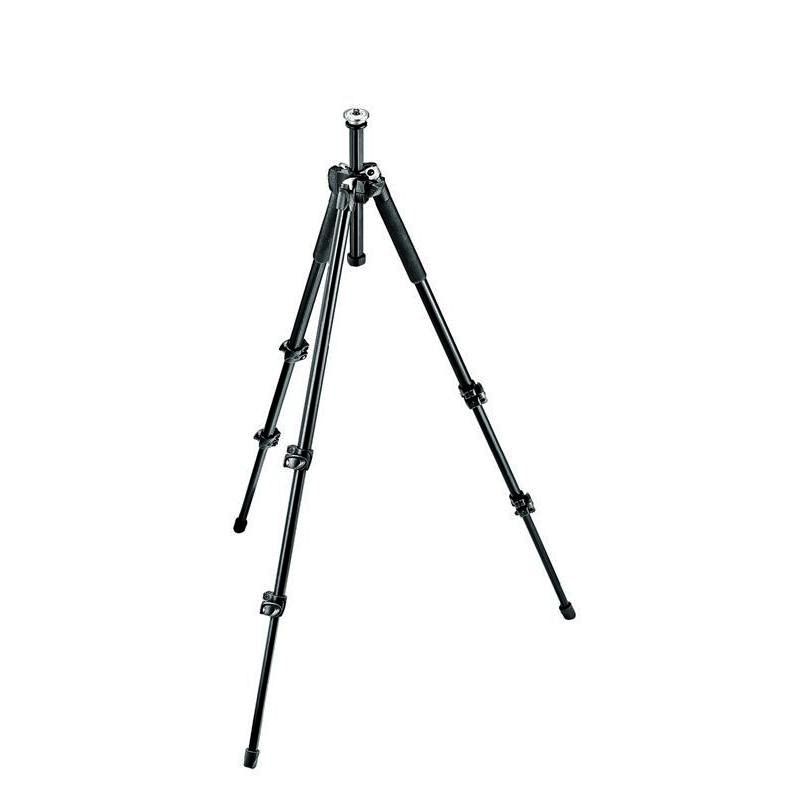
The Manfrotto MT293A3 is a discontinued three-section aluminium tripod from Manfrotto’s older 290 Series. It was designed as a straightforward support for enthusiast photographers who wanted more stability than a lightweight travel tripod without moving into a much heavier professional system.
In 2026, the MT293A3 is mainly a used-market purchase. Its simple construction, approximately 4kg payload rating and replaceable head make it useful for landscapes, portraits and studio work, but it is relatively bulky for travel and lacks several conveniences found on newer tripods. Condition and price now matter more than the original marketing claims.

Manfrotto MT293A3 specifications
| Feature | Specification |
|---|---|
| Construction | Aluminium |
| Leg sections | Three |
| Maximum height | Approximately 151cm with centre column extended |
| Height without raised column | Approximately 130cm |
| Minimum height | Approximately 36.7cm |
| Folded length | Approximately 55.7cm |
| Weight | Approximately 1.5kg |
| Rated payload | Up to 4kg |
| Leg-angle positions | Two positions, approximately 23° and 51° |
| Head supplied | Depends on the original kit; tripod legs accept a separate head |
| Head connection | 3/8-inch mounting screw |
Specifications can vary slightly between regional listings and kits, especially when a head was bundled with the legs. When buying used, check the exact item in the photographs rather than assuming that a ball head, three-way head, plate or carrying bag is included.
Build quality and stability
The MT293A3 uses aluminium three-section legs with D-shaped tubes. Three sections mean fewer joints than a four- or five-section travel tripod, which helps rigidity and makes setup relatively quick. The trade-off is a folded length of about 56cm, so it is not especially compact.
At roughly 1.5kg before adding a head, it feels more substantial than an ultralight travel model. That extra mass can be helpful when working outdoors in moderate wind or when using a longer lens. It is still important to keep the centre column as low as practical: raising it to maximum height reduces stability on almost any tripod.
The quoted 4kg payload should be treated as an upper limit rather than a guarantee of perfect performance. A tripod can physically support a camera while still allowing vibration. The weight, length and balance of the lens, the quality of the head, wind and ground conditions all influence real stability.
Height and working position
With the centre column extended, the tripod reaches approximately 151cm before the height of the head and camera is added. Many photographers can therefore work close to eye level. Keeping the column down reduces the working height to around 130cm but provides a firmer platform.
The two leg-angle settings help on uneven ground and allow a lower shooting position. A minimum height around 36.7cm is adequate for many landscapes and low compositions, although it is not especially low by modern standards. Reversing the centre column can place the camera closer to the ground, but operating a camera upside down is slower and less convenient than using a tripod with a lateral or short column.
Leg locks and centre column
Flip locks make the three leg sections fast to extend and collapse. They are convenient when a scene changes quickly, but used examples need careful inspection. A loose lock may allow a leg section to slide under load, while a lock tightened too aggressively can damage components.
The triangular centre column is designed to resist rotation. An anti-shock collar reduces the chance of the camera dropping abruptly if the column lock is released, but it is not a substitute for holding the camera while adjusting the column.
Foam grips on the upper leg sections make the tripod more comfortable to carry and handle in cold weather. On an older example, check whether the foam has split, become sticky or started to detach. Cosmetic wear is not necessarily serious, but corrosion, bent tubes or cracks around the leg shoulders deserve more caution.
Tripod head compatibility
The MT293A3 legs use a standard 3/8-inch head mounting screw, so the tripod can accept many ball heads and three-way heads. Some original kits were sold with a Manfrotto head, while other listings contained only the legs.
A ball head is compact and quick for general photography. A three-way head offers more deliberate control for architecture, studio work and precise landscapes but adds bulk and weight. Before buying a used kit, confirm that the quick-release plate matches the head; replacement plates can be model-specific.

Performance in practical photography
Landscape photography
The tripod’s aluminium construction and three-section legs suit deliberate landscape work. It can help with bracketing, long exposures and carefully aligned panoramas. For sharper results, extend the thickest leg sections first, avoid raising the centre column unless necessary and use a remote release or the camera’s self-timer. Our guide to shutter speed explains when stable support becomes especially valuable.
Portraits and studio work
The MT293A3 is also useful for consistent framing during portraits, product photography and repeated studio setups. Its folded size matters less indoors, and the adjustable head connection lets the photographer choose a head suited to the work.
Macro photography
For macro subjects, the two leg angles and reversible centre column provide some flexibility. However, the tripod is less convenient near ground level than newer models with a short or lateral column. A focusing rail or carefully positioned ball head may help. See our macro photography guide for focusing, lighting and stability techniques.
Travel photography
Travel is where the design feels dated. A folded length near 56cm and a weight around 1.5kg before the head make it less convenient for flights, long walks and small backpacks than a modern carbon-fibre travel tripod. It remains transportable, but buyers should choose it for stability and value rather than minimum size.
What cameras can it support?
The 4kg rating covers many mirrorless cameras and DSLRs with moderate lenses, provided the head is also rated appropriately. A compact body with a standard zoom is an easy match. A larger camera with a long telephoto lens may remain within the numerical limit but create much more leverage, making the head and technique increasingly important.
Mount a lens with its tripod collar whenever one is provided. This balances the combination over the head and reduces strain on the camera mount. Do not rely solely on the payload number when using valuable equipment in wind, on slopes or near water.
Buying the MT293A3 used
Inspect all three leg sections and extend them fully. Each flip lock should close firmly and prevent movement without requiring excessive force. Check the leg-angle selectors, centre-column lock, rubber feet and the casting where each leg joins the body.
- Look for bent tubes, cracks, corrosion and missing screws.
- Check that the centre column moves smoothly and does not rotate when locked.
- Confirm whether a head and compatible quick-release plate are included.
- Test every head movement and lock with a camera-sized load.
- Check for excessive play where the legs meet the centre casting.
- Compare the total cost with a newer tripod offering replacement-part support.
Replacement components may still appear through dealers or the used market, but availability should not be assumed for a discontinued model. A low price is attractive only if the tripod is structurally sound and includes the parts you need.
Advantages and limitations
Advantages
- Rigid three-section aluminium legs
- Quick flip-lock setup
- Useful working height
- Standard 3/8-inch head connection
- Two leg-angle positions
- Often affordable on the used market
Limitations
- Discontinued model
- Bulky beside modern travel tripods
- Not especially light once a head is fitted
- Only two leg-angle positions
- Limited convenience for very low shooting
- Used condition varies considerably
Final verdict
The Manfrotto MT293A3 remains a practical tripod if you find a complete, well-maintained example at a sensible price. Its strongest qualities are simple operation, respectable rigidity and compatibility with interchangeable heads. It suits landscapes, portraits and home or studio use better than lightweight travel.
Its age should shape the buying decision. It is larger and less flexible than many newer alternatives, and replacement parts or missing accessories may reduce its value. Inspect the locks and castings carefully, confirm exactly what the listing includes and avoid paying a premium simply for the Manfrotto name.
Check current Manfrotto 290 availability on Amazon.
Affiliate disclosure: As an Amazon Associate, GottaPics may earn from qualifying purchases at no additional cost to you.
Discover more from GottaPics
Subscribe to get the latest posts sent to your email.


 Marian Florinel Condruz
Thank you so much for your article, you are a lifesaver! I love photography but I don’t like spending time looking at all the different equipment that a photographer needs I really just want to take photos. I have wanted/needed a tripod for sometime but I hate trying to figure out which is best. I love this Manfrotto 290 Series MT293A3 Tripod. It offers what I need:
The ability to open the legs lower and broader, quick set-up and a high-quality Aluminum disc with 3/8 so I can use a variety of heads. These are the features I have been looking for and this tripod is very reasonably priced. I will look closer at this tripod because it sounds perfect. Thanks so much for researching this item and doing all the legwork.
Glad I proved myself to be helpful… If you need further advise, please ask here