

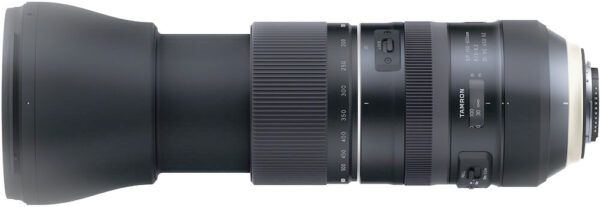
The Tamron SP 150–600mm F/5–6.3 Di VC USD G2, model A022, is a full-frame ultra-telephoto zoom designed primarily for wildlife, birds, motorsport and other distant subjects. It replaced Tamron’s original 150–600mm G1 with improved autofocus, stronger construction, better close focusing, revised stabilisation and more effective weather protection.
The G2 remains relevant because it provides genuine 600mm reach at a price and weight below many professional primes. It is not a small lens, and its f/6.3 maximum aperture at 600mm places real demands on light, autofocus and technique. Nevertheless, a good used example can still offer substantial value for DSLR photographers and some mirrorless users working through a compatible adapter.
Tamron 150–600mm G2 specifications
| Feature | Specification |
|---|---|
| Model | A022, second generation (G2) |
| Focal length | 150–600mm |
| Maximum aperture | f/5 at 150mm to f/6.3 at 600mm |
| Minimum aperture | f/32–40 |
| Optical construction | 21 elements in 13 groups |
| Diaphragm | 9 rounded blades |
| Minimum focus distance | 2.2m |
| Maximum magnification | 1:3.9 |
| Filter size | 95mm |
| Stabilisation | VC with three modes; rated at approximately 4.5 stops in Mode 3 |
| Autofocus motor | Ring-type USD |
| Weight | Approximately 1,990–2,010g, depending on mount |
| Original mounts | Canon EF, Nikon F and Sony A variants |
This review specifically concerns the G2 A022. Tamron’s first-generation A011 looks similar and covers the same focal range, but its construction, minimum focus distance, stabilisation controls and handling differ. Check the model number before buying.

Build quality and handling
The G2 feels considerably more substantial than an ordinary consumer zoom. Its metal outer barrel, broad zoom ring and removable tripod collar are designed for regular field use. Moisture-resistant seals and a fluorine coating on the front element provide useful protection against light rain, fingerprints and dirt, although the lens should not be treated as waterproof.
At roughly 2kg before adding the camera, the lens requires deliberate handling. Many photographers can use it handheld for short periods, but fatigue becomes significant during a long wildlife session. Supporting the barrel with the left hand, using a stable stance and lowering the camera between sequences makes a practical difference.
The tripod collar is removable and rotates for horizontal or vertical framing. Its foot is compatible with Arca-style clamps, which can simplify mounting, although fit should always be checked with the specific clamp. When carrying the combination, support the lens rather than allowing its weight to hang from the camera mount.
Zoom controls and Flex Zoom Lock
The barrel extends as the lens zooms from 150mm to 600mm. A conventional lock secures it at the transport position, while Tamron’s Flex Zoom Lock can hold the barrel at any focal length by sliding the zoom ring forward.
Flex Zoom Lock is useful when pointing the lens upward or downward because it limits unwanted zoom creep. It can also prevent the focal length changing while tracking a subject. Buyers should test that the mechanism engages and releases cleanly; forcing the zoom while it is locked can cause damage.
Image quality
The G2 uses three low-dispersion elements and Tamron’s anti-reflection coatings to control chromatic aberration, flare and ghosting. In practical use, the strongest results generally come from the middle of the zoom range, but the lens remains capable at both 150mm and 600mm when focus, shutter speed and atmospheric conditions are controlled.
At 150mm, central detail is strong and the lens is useful for larger wildlife, field sports and compressed landscapes. Performance remains useful through the mid-range, where the maximum aperture gradually narrows. At 600mm, fine detail can soften compared with shorter settings, especially wide open, but stopping down moderately can improve consistency when light allows.
Long-distance image quality is not determined by the lens alone. Heat shimmer, humidity and haze can destroy detail even when the camera is perfectly focused. Moving closer to the subject often improves results more than changing settings or adding a teleconverter.
Autofocus performance
The ring-type USD motor provides fast, quiet autofocus and full-time manual override. On a suitable DSLR in good light, it can track birds, vehicles and field sports effectively. The focus limiter helps by preventing the lens from searching across its entire distance range when the subject is known to be far away.
Performance depends heavily on the camera body. A lens at f/6.3 gives the autofocus system less light than an f/4 telephoto, so tracking becomes less dependable at dusk, under cloud or against low-contrast backgrounds. Older cameras may also have fewer sensitive focus points or slower subject tracking.
Used examples should be tested at several distances and focal lengths. Repeated hesitation, erratic hunting or focus that consistently falls in front of or behind the subject may indicate a compatibility, calibration or mechanical issue rather than normal behaviour.
Vibration Compensation modes
Canon EF and Nikon F versions include Tamron’s Vibration Compensation system with three operating modes:
- Mode 1: a balanced general-purpose setting that stabilises the viewfinder and the captured image.
- Mode 2: designed for panning, allowing intentional movement along one axis.
- Mode 3: prioritises stabilisation at the moment of exposure rather than continuously providing the steadiest viewfinder image.
Tamron rated Mode 3 at approximately 4.5 stops under its CIPA test conditions. Real results vary with focal length, technique and subject movement. Stabilisation reduces blur caused by the photographer; it cannot freeze a moving animal or athlete. Our shutter speed guide explains how to select a speed for both camera movement and subject motion.
The Sony A-mount version relies on compatible camera-body stabilisation rather than including the same optical VC system. Confirm the exact mount and feature set before buying.
Handheld use versus a tripod
The lens can be handheld, particularly in bright light and for subjects that move unpredictably. VC, good stance and short bursts increase the chance of a sharp frame. At 600mm, many photographers still need shutter speeds around 1/1000 second or faster for active wildlife, regardless of stabilisation.
A monopod reduces fatigue while retaining freedom to follow action. A tripod with a suitable gimbal or fluid head is more comfortable for long waits, hides and repeated framing. The support system must safely handle the combined weight of the camera and lens, not merely the lens on its own.
When the camera is firmly mounted, consult the lens instructions and test whether VC helps or introduces movement in the specific setup. Technique, head rigidity, shutter speed and the surface beneath the tripod all affect the result.
Close focusing
The G2 focuses as close as 2.2m and reaches a maximum reproduction ratio of 1:3.9. That is a meaningful improvement over the G1, but it is not true 1:1 macro. The long working distance is useful for butterflies, dragonflies, flowers and other subjects that are difficult to approach.
Depth of field becomes very shallow near the minimum focus distance. Accurate focus, controlled background placement and adequate shutter speed are more important than the word “macro” in a listing. For dedicated close-up methods, see our macro photography guide.
Teleconverters
Tamron produced dedicated 1.4x and 2x teleconverters for compatible combinations. They increase potential reach but also reduce the effective aperture and place greater demands on autofocus, light and technique.
With a 1.4x converter, the lens becomes approximately 210–840mm and loses one stop of light. A 2x converter produces approximately 300–1200mm and loses two stops. At the long end, the effective aperture becomes too slow for dependable autofocus on many camera bodies. Cropping a sharp image from the bare lens can sometimes deliver a better practical result.
Mount and camera compatibility
The A022 was produced for Canon EF, Nikon F and Sony A DSLR or SLT systems. It is not a native Sony E, Canon RF or Nikon Z lens. Some photographers use the Canon or Nikon versions on mirrorless cameras through appropriate adapters, but autofocus, stabilisation and firmware behaviour can vary.
Before buying for an adapted setup, check Tamron’s current compatibility information for the exact lens mount, camera body, adapter and firmware. Do not assume that compatibility with one body guarantees identical behaviour on another. Tamron’s official A022 product information is a useful starting point.
TAP-in Console adjustments
Compatible versions can use Tamron’s optional TAP-in Console for firmware updates and certain custom adjustments. These may include focus fine-tuning at selected distances and focal lengths, VC behaviour and focus-limiter settings.
The console is useful but should not be treated as a cure for mechanical faults. If a lens focuses inconsistently, freezes or makes unusual noises, test it carefully before attempting calibration. Updates should be performed with the correct console for the lens mount and uninterrupted power.
Buying a used Tamron 150–600mm G2
A used ultra-telephoto lens deserves more inspection than a small standard zoom. Its weight, extending barrel and frequent outdoor use can expose wear that is not obvious in listing photographs.
- Confirm the A022 model number and the correct camera mount.
- Inspect both elements for scratches, coating damage, fungus, haze and excessive internal dust.
- Zoom through the full range and test both the transport lock and Flex Zoom Lock.
- Check autofocus repeatedly at short and long distances.
- Test all VC modes and listen for abnormal grinding or knocking.
- Inspect the mount, weather seal, switches and tripod collar.
- Confirm that the hood, caps, collar and case are included if advertised.
- Check firmware and adapter compatibility for a mirrorless setup.
Minor dust is common and may not affect photographs, but fungus, haze, impact damage or inconsistent autofocus can be expensive problems. Whenever possible, test the lens on your own camera and inspect sharp files at 150mm, the middle range and 600mm.
Advantages and limitations
Advantages
- Versatile 150–600mm range
- Strong value on the used market
- Effective VC on Canon and Nikon versions
- Useful focus limiter and Flex Zoom Lock
- Improved close focus over the G1
- Moisture-resistant construction
- Removable Arca-compatible tripod collar
Limitations
- Approximately 2kg before the camera
- f/6.3 maximum aperture at 600mm
- Some softening at the longest setting
- Autofocus depends heavily on light and camera body
- Teleconverters reduce autofocus reliability
- Not native to current mirrorless mounts
- 95mm filters are expensive
Final verdict
The Tamron 150–600mm G2 remains a credible long-lens option for photographers who need reach without the price of a large professional prime. Its handling, stabilisation, autofocus and close-focus performance represent meaningful improvements over the original G1.
It delivers its best value when paired with a compatible camera, adequate light and realistic technique. The weight and f/6.3 aperture are unavoidable compromises, and adapted mirrorless use requires careful compatibility checks. A clean, accurately focusing example at a sensible price can still be an excellent wildlife or motorsport lens.
Check current Tamron 150–600mm G2 availability on Amazon.
Affiliate disclosure: As an Amazon Associate, GottaPics may earn from qualifying purchases at no additional cost to you.
Discover more from GottaPics
Subscribe to get the latest posts sent to your email.


 Marian Florinel Condruz