

Affiliate disclosure: This article contains an Amazon affiliate link. If you buy through it, I may receive a small commission at no extra cost to you.
The Sony WX500 offers something a phone still struggles to reproduce: a genuine 30x optical zoom in a camera small enough for a coat pocket. Its 24–720mm-equivalent Zeiss lens can move from a wide holiday scene to a distant detail without changing lenses.
That reach is the reason to consider it. The trade-off is a small 1/2.3-inch sensor, no RAW capture, no electronic viewfinder and limited low-light quality. The WX500 makes sense only when long zoom matters more than maximum image quality.
What the Sony WX500 offers
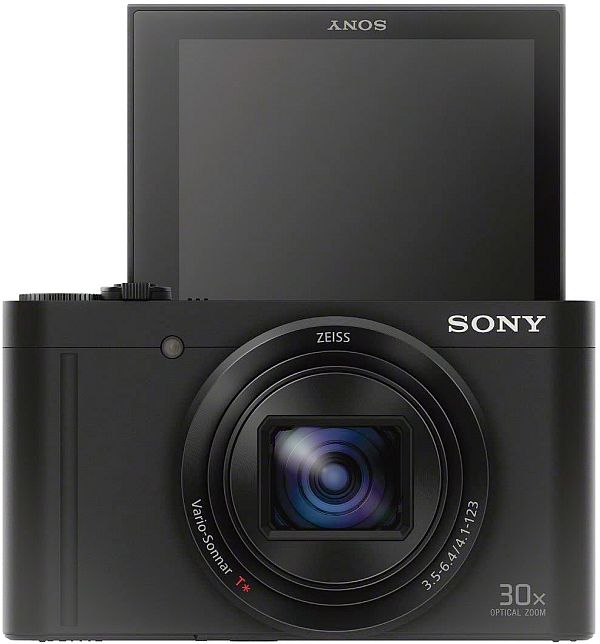
The camera combines an 18.2-megapixel backside-illuminated Exmor R CMOS sensor with a 30x optical zoom and optical stabilisation. Its rear screen tilts upwards by 180 degrees, and it includes Wi-Fi and NFC for compatible mobile connections.
At roughly 236g with battery and memory card, it is far easier to carry than an interchangeable-lens camera with a lens reaching 720mm equivalent. That convenience is its real achievement.

The 24–720mm-equivalent zoom
At 24mm equivalent, the lens is wide enough for landscapes, buildings, groups and ordinary travel scenes. At 720mm equivalent, it can frame distant architecture, animals, aircraft or details that would appear tiny in a phone photograph.
A 30x zoom does not guarantee a sharp image. At the long end, every small movement is magnified. Optical SteadyShot helps reduce shake from the photographer, but it cannot freeze a moving subject. Good light and an appropriate shutter speed are essential.
The maximum aperture changes from f/3.5 at the wide end to f/6.4 at full telephoto. This means the lens becomes relatively slow as it zooms, forcing the camera to raise ISO or use a slower shutter speed when light is limited. The longest focal lengths are therefore most useful outdoors during the day.
Image quality and the small sensor
The 1/2.3-inch sensor is much smaller than the one-inch sensor in Sony’s RX100 series. In bright conditions, the WX500 can produce colourful and detailed images for online use, family albums and moderate prints. As light falls, noise reduction removes fine texture and images become softer.
The camera records JPEG files but not RAW. That keeps the workflow simple, but it also limits recovery of highlights, shadows and white balance after the photograph is taken. Exposure needs to be reasonably accurate in camera.
More megapixels do not remove the limits of sensor size. The WX500 should be bought for zoom versatility rather than for extensive editing, shallow depth of field or demanding low-light work. Our guide to camera ISO explains why raising sensitivity affects fine detail and noise.
Screen, controls and handling
The three-inch screen tilts upwards by 180 degrees, making it useful for low-angle shooting and self-framing. It does not tilt downwards and is not touch-sensitive. Focus points, menus and settings are controlled with the physical buttons and rear wheel.
There is no built-in electronic viewfinder. In bright sunlight, seeing the screen clearly can be difficult, and holding the camera away from the face is less stable at 720mm equivalent. The related Sony HX90V is a better fit for photographers who need a viewfinder, although used prices and availability vary.
PASM modes provide more exposure control than many simple compacts. However, the small body leaves little room for dedicated buttons, so changing settings is slower than on a larger camera. Automatic modes remain the easiest way to use it for casual travel photographs.
Autofocus and stabilisation
The autofocus is adequate for landscapes, buildings, portraits and other predictable subjects in decent light. At full zoom or in dim conditions, it can slow down or search. It is not a modern wildlife or sports autofocus system.
Optical SteadyShot is especially important with such a long lens. Use a stable stance, support your elbows and take several frames when the subject allows it. A tripod can help with static subjects, but moving animals and people still require sufficient shutter speed.

Video and self-framing
The WX500 records Full HD video, including XAVC S, but not 4K. The flip-up screen allows the operator to check framing from in front of the camera, which can be useful for casual pieces to camera and holiday clips.
There is no microphone input, so audio depends on the built-in stereo microphones. The screen can also be partly obstructed if an accessory is mounted near the camera. It works for informal recording, but it is not a complete modern vlogging solution.
Intelligent Active Mode helps stabilise video, although it cannot remove every movement, particularly at long focal lengths. For walking footage, wider settings are much easier to manage than 720mm equivalent.
Wi-Fi and phone connection
The camera includes Wi-Fi and NFC for transferring images and remote operation with compatible devices. Sony’s mobile software and current phone operating systems have changed since the WX500 was introduced, so buyers should confirm compatibility with their own phone.
Wireless transfer is useful for selected JPEGs, but it is slower than a modern phone-first workflow. Fortunately, photographs can always be copied from the memory card with a card reader.
Battery life and portability
Sony rated the WX500 for about 400 still images per charge under CIPA testing. Real use depends on zooming, screen brightness, video and wireless activity. The NP-BX1 battery is small and older examples may have lost capacity, so a reliable spare is worthwhile.
The retracting lens makes the camera easy to pack, but it is also its most vulnerable mechanical component. A protective pouch prevents dust and pressure inside a bag. The smooth body should always be used with the wrist strap.

What the WX500 does well
- Huge 24–720mm-equivalent range in a pocketable body
- Optical image stabilisation
- Useful 180-degree tilting screen
- Full manual exposure modes
- Full HD XAVC S recording
- Good battery rating for a small compact
- Built-in flash, Wi-Fi and NFC
- Easy to carry as a daylight travel camera
Important limitations
- Small 1/2.3-inch sensor
- No RAW capture
- No electronic viewfinder
- No touchscreen
- No 4K video or microphone input
- Lens falls to f/6.4 at full zoom
- Low-light image quality is limited
- Autofocus is not designed for demanding action
Who should buy it?
The WX500 suits travellers who want a long optical zoom without carrying a large bridge camera or interchangeable lenses. It also makes sense for daylight sightseeing, family trips, aircraft spotting and occasional distant wildlife when convenience matters most.
It is less suitable for night photography, indoor action, heavy editing or photographers who need a viewfinder. If image quality matters more than reach, a one-inch compact such as the Sony RX100 III is the stronger type of camera, although its lens stops at 70mm equivalent.
Buying a used Sony WX500
Extend the zoom through its complete range several times. It should move smoothly without grinding, hesitation or lens errors. Take test photographs at wide, middle and full telephoto settings and inspect them at full size for uneven softness, dust or stabilisation problems.
Move the flip screen while it is displaying a live image and watch for flickering or interruption. Test every button, the control wheel, flash, USB charging, HDMI connection and Wi-Fi startup. Check the battery compartment and ports for corrosion.
Pay particular attention to impact marks around the lens barrel. A camera that has been dropped while extended may still switch on but produce soft or misaligned images. A weak NP-BX1 battery is common and should be reflected in the price.
Sony lists the full details on its official WX500 specification page. Manuals and available downloads are found through the Sony WX500 support page.
What you need besides the camera
A suitable SD card, spare NP-BX1 battery, wrist strap, small padded pouch and lens cloth cover most journeys. For distant static subjects or low-light landscapes, a stable support is useful. Our Benro Rhino tripod review explains a sturdy travel option, while a lighter mini tripod may suit the WX500 better for casual use.

The 30-Second Decision
Buy it if you want maximum daylight zoom in the smallest practical package and find a clean used example at a modest price.
Skip it if you need RAW files, strong low-light quality, an eye-level viewfinder, 4K video or dependable action autofocus. A newer phone may also be more convenient when most photographs are taken at wide angles.
Final verdict
The Sony WX500 is defined by its 30x zoom. It gives travellers a range that phones cannot match optically, while remaining small enough to carry every day.
Its small sensor and ageing features prevent it from being an all-purpose high-quality camera. Used in good light and with realistic expectations, however, it can still be a useful pocket companion for subjects that are simply too far away for a phone.
Check Sony WX500 availability on Amazon
Discover more from GottaPics
Subscribe to get the latest posts sent to your email.


 Marian Florinel Condruz